In this tutorial am telling how to discover if the family address or the ancestor’s job are mentioned, or to understand if a relative or parent was dead or alive at the moment of the record.
I am showing how to spot troublesome births, marriages between cousins, and unusual causes of deaths, and I am revealing a few tricks
If you watch it and find it useful for your research, let me know!
I will follow up with other two videos:
How to spot if an ancestor was an abandoned baby (an important part which I forgot in this video!)
Update to 2026 A.I. (in this video I am suggesting how to use it, but in the meantime much has changed with A.I. and I will update my suggestions)
(not the usual tragic story about a WWI soldier… another kind of tragic story)
Giacomo P. was born in a small town in the mountains in North Italy, in 1879, and by the time he was 37, in the year 1916, he was still unmarried.
He probably had a fiancée, though: Tersilla.
In 1916 Italy was fighting in the First World War: boys were leaving their girlfriends at home, promising to marry them at the end of the war, and knowing that many of them would not come back to fulfill their promise.
Giacomo, instead, married Tersilla long before the end of the war, when he was still a soldier, probably taking advantage of a permit.
They married in March 1916 and the reason for this urgency is easy to understand: Tersilla was pregnant!
Their baby, Antonio, was born less than 4 months later and a note at the bottom of his birth record confirms that his father was absent, under arms.
Giacomo probably saw his son for the first time months later, and could only enjoy the event of his birth through the many letters that soldiers were exchanging with their families.
He surely came home around September 1917, because Tersilla was pregnant again and delivered another son, Giovanni, in June 1918.
Giacomo was declared absent because he was “called again to the arms”, so probably he had enjoyed a long permit or was exempted from service for some reason.
However, in 1918 Italy was struggling because of the war: the number of casualties and wounded soldiers was enormous and there were no more “spare boys” to call to fight, so no justification was strong enough to be exempted from fighting.
Giacomo left therefore his pregnant wife home alone and probably received the news about Giovanni’s birth by letter, again.
He surely prayed to be able to come back home and hug his newborn child soon, but he probably never did it: they all died in 1918. The two babies and Tersilla.
The causes of their deaths are not reported in the records but they may have died of Spanish flu: another tremendous adversity that hit Italy just in 1918.
When Giacomo came back home from war, after having escaped God knows how many risks, his family was destroyed, his house was empty.
He had had a wife for two years, but he probably stayed with her only for a very short time.
He had a son, but he likely saw him only once or twice.
And he had a last son, who he probably never met.
He was the one who had been most at risk of death, and he was the only one to survive.
This was the end of his first life, but he will start a second one.
In 1921, Giacomo married again, to Marianna. His new wife was a very old spinster: she was 42! And she was… Tersilla’s oldest sister!
Despite her age, at the wedding Marianna was 8 months pregnant, too!
Giacomo and Marianna had a son and a daughter. And life went on.
GOOD TO KNOW
In Italy, today, the religious marriage and the civil marriage are joined in one: at the end of the religious ceremony the priest includes the civil formulas and takes care that the civil records are duly complied and signed. In the past they were two different events, which may be held even days or months apart.
In the cases of Tersilla and Marianna I “gossiped” about them being pregnant without being married, but this may not be true: perhaps they had celebrated the religious marriage before being pregnant, and they celebrated the civil marriage months later.
The info for this story was taken from civil records only
I am so happy that I had a small role in this documentary about the emigration from the Italian region Valle d’Aosta to South Africa!
I am very grateful to the film maker Joseph Péaquin for involving me in this amazing job!
Here is the trailer of the documentary, whose preview will be in Aosta on March 14th, 2024.
It all started with serendipity: I was doing genealogical research at the Diocese Archive in Aosta last year and I told the archivist that my Customer’s ancestor emigrated from Valle d’Aosta to South Africa.
The archivist told me that a documentary was going to be made about emigration from that region to South Africa, and that the Producer may have been interested in my Customer’s story.
One year later, both my Customer and I appear in the same video!
Despite my shyness and my absolute embarassment and inadequacy in front of a video camera, it was a great experience!
Don’t miss the other documentary about emigration from Valle d’Aosta to the USA, which was made last year.
After writing a post about the most beautiful archive found so far, here is a selection of the WORST ARCHIVES I had the chance to work in.
It is just for a laugh, not to criticize. For this reason, I made the places not recognizable (I hope) with a strong post-processing and effects-addition on the original pictures, so that nobody would feel bad about it.
These three parish archives are in Piedmont.
THE REGISTERS ON THE FLOOR
I swear it was not my idea, it was the parish cooperator who pulled them out of the furniture and laid them on the carpet, because all other surfaces were covered with a variety of different stuff.
So, I mostly worked on my knees on the floor.
I can confirm that the carpet was very soft and the registers did not suffer any mishandling or damage!
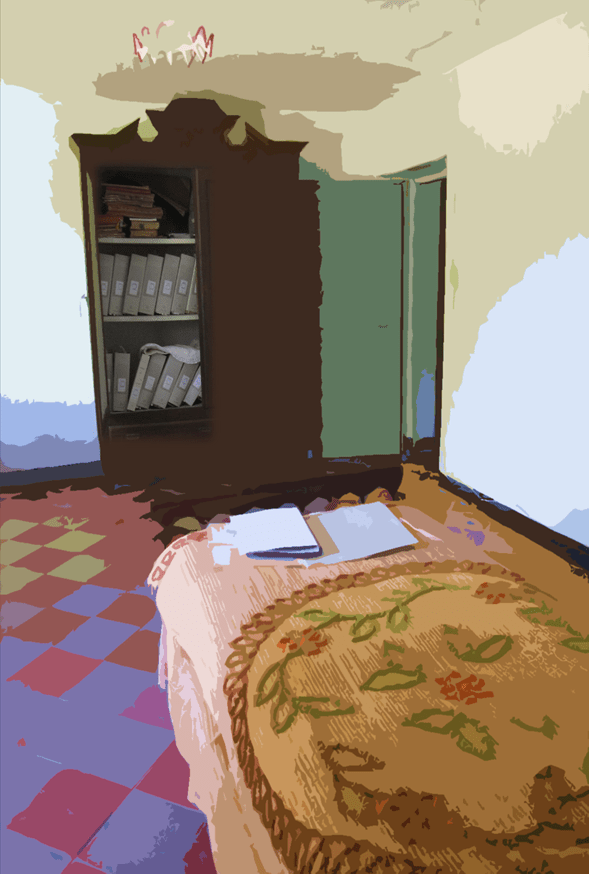
THE BEDROOM
When you are in a very small town with a very small parish and a very small priest’s house that hosts a parish archive, where is the archive?
In the kitchen? In the bathroom? Of course, neither of them is suitable.
It’s in the bedroom!
Fancy a nap?
WORKING WITH A VIEW
OK, this was another archive without a table, without a chair, without a bed, without a surface to put the registers on. No carpet this time, and the floor was filthy.
The best solution was to use the windowsill, after having roughly cleaned it from dust, pieces of concrete, spider webs and dead stink bugs (and I was lucky that it had just stopped raining).
I was inspired for this series of posts by the many requests for help that are posted on Facebook groups, where assistance in understanding handwritten records is asked.
Handwriting can be an issue, and not only for foreigners. Sometimes, even Italians struggle with unintelligible words and sentences.
Well, believe it or not, in some cases it is possible to bypass the handwriting problem.
We could call it…
INVESTIGATE INSTEAD OF INVENT
Here is my third post and it is dedicated to FAMILY NAMES
The previous ones were dedicated to PLACE NAMES and FIRST NAMES, here are the links, if you missed them:
I am not going to teach you how to read a particular calligraphy. I am going to give you some hints which may be helpful to interpretate the correct name.
INFO AND SOME TIPS ABOUT FAMILY NAMES
In the Italian rural society of the past, families were usually deeply rooted in their town of origin. For this reason, some surnames were very common in a specific town and absent in other towns. If you cannot figure out the correct spelling of a family name, browse other pages or possibly the INDEX of the register: you may discover more occurrences and find out the correct spelling. Do not limit your search to the index of the same register you are browsing: if the handwriting of the record is bad, that of the index may be the same one. Search for a better index, even many years before or after: as said, families were rooted in the town and so, you may find the same names reported also in the usually clearer 20th century registers.
2. If this is not possible, check if the surname is still present in town.
Unlike other online telephone guides, providing results only if you input the correct surname, this one shows you the list of all surnames in town.
This is very useful especially if you did not catch the initial letter of your surname: check all initial letters and you may find the correct surname.
Procedure:
Select the province
Select the town
Select the initial letter
This website is based on search entries, not only on surnames, so you may find entries like “hotel” or “taxi” (besides a lot of annoying ads, I am sorry).
3. If the researched surname is definitely not specific of that town, you may double-check the surnames of the surrounding towns: people were not usually moving to distant towns, so it is possible that the person you are searching for was coming from a nearby one.
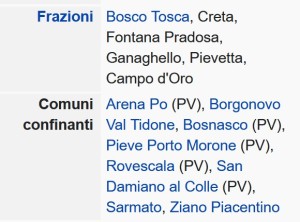
To find out the neighboring towns, use the Italian version of Wikipedia: digit the town and you will find them listed on the right margin (Comuni confinanti).
Choose indexes written in a readable way and browse through the surnames.
4. Check if your ancestor signed at the bottom of the record: his handwriting may be clearer than that of the clerk or priest (and you also win a copy of your ancestor’s autograph!)
5. Just like I explained for first names, Italian family names follow the rules of Italian grammar, so some combinations of letters are more likely than others. Here are some basic rules to help with the correct spelling. The letters C, D, F, G, L, R, S, T, V and Z are not preceded by M, they must be preceded by N. Examples: Bianchi, Conti, D’Angelo The letters P and B are not preceded by N, they must be preceded by M Examples: Colombo, Campi.
Surnames usually end with a vowel, like the majority of Italian words.
Only in a few cases they end with a consonant, and this is usually N (especially in Veneto and North-Easter Italy), R, S, T or L.
Surnames ending with other consonants (Kovac, Martinez) hint at a foreign origin.
6. Many Italian surnames derive from patronymics, hence referring to an ancestral patriarch: De Luca, De Angelis, D’Adamo, De Bernardi etc. If the surname you are struggling to understand starts with De or Di, maybe the following word is a first name (in Italian or perhaps in Latin). In many cases, the De is omitted, and the surname is resembling more closely a first name: Bernardi, Mauri, Tonietti (from Antonio), Tommasini
7. Surnames deriving from toponyms are also very frequent. They refer to the ancestral place of origin of the family: a nation, a region, a city, a town or even a hamlet of a town. It’s the case of surnames like Spagnoli, Pugliese, Siciliano, Romano, Milano, Messina, Gissi (my surname and also a town in Abruzzo). If you have doubts about the correct spelling of your researched surname, you may find inspiration on Google Maps! Perhaps it originates from the name of a nearby place.
8. If you are struggling to spot your family on registers written in Latin, consider that the family name may have been translated into Latin! For example, Rossi may have been recorded as Rubeis. The following image shows the Latin version of the surname Della Casa Grande (meaning: From the Big House, hence the orphanage. It was a typical surname for foundlings) Della Casa Grande was translated “De Domo Magna“, which has the equivalent meaning in Latin, but it’s not so easy to catch if you don’t know both languages.
(Don’t despair! Even if you do not know the meaning of the researched surname, and you wouldn’t be able to translate it into Latin, I must admit I stumbled upon this circumstance only occasionally).
I hope these few tips were helpful and I wish you good search!
I was inspired for this series of posts by the many requests for help that are posted on Facebook groups, where assistance in understanding handwritten records is asked.
Handwriting can be an issue, and not only for foreigners. Sometimes, even Italians struggle with unintelligible words and sentences.
Well, believe it or not, in some cases it is possible to by-pass the handwriting problem.
We could call it…
INVESTIGATE INSTEAD OF INVENT
Here is the first post dedicated to PLACE NAMES
In the above record, the writer was probably confident to be smart and to create something artistic in his bureaucratic job, thanks to this fancy calligraphy.
Just the opposite, 150 years later these words are hardly readable (and the blurry scan doesn’t help).
Now, I am not going to teach you how to read this particular calligraphy. I am going to explain you the
TIPS TO UNDERSTAND
the most important info about places.
START
If you can’t understand a place mentioned in the record, start from what you know, i.e. the town of the record (if you have the record, you should know which is the municipality or church that issued it).
At first, try to isolate some letters composing the “mystery place”.
In the above record issued by the municipality of Castel San Giovanni (province of Piacenza, region Emilia Romagna) other two towns are mentioned.
The first “mystery place” starts with Borgo, but there are hundreds places starting with BORGO, in Italy. Which is the right one?
Second example from the same record: this place name is a long name, ending with “GO” and having a “O” as a second letter. Can you understand more? That’s even better!
FIRST TIP
Use WIKIPEDIA
Go to the Italian page of the known town – Castel San Giovanni, in this case – and check its hamlets under the section FRAZIONI (right column) as well as the neighboring towns in the section COMUNI CONFINANTI.
Very often, the mystery place falls into one of these two options.
Ok, the place from the first example is surely BORGONOVO, a neighboring town. Can you read it now?
Checking the hamlets of all neighboring towns is also very useful, if this first attempt fails.
The place from the second example does not look like anyone in this list, though. We must go further.
This site provides info about all Italian towns and cities, both existing and no longer existing.
Digit some letters of the “mystery place”, the ones you understand, and you will get many records sorted out by region and province. Usually, the “mystery place” is close to the known place.
For example, by digiting simply “GO” and filtering by region Emilia Romagna and province Piacenza, you will get the following results
GOSSOLENGO is the town that matches with the place mentioned in the record. A quick check with Google Maps will help you discovering that it is very close to Castel San Giovanni.
You can use this site to search any town name in Italy, even if you don’t know where to start from.
For example, if you have a non-Italian record mentioning the town, without any clue about where it is situated, try with Elesh and you may find the correct town name.
THIRD TIP
If you can’t find a place which has been transcribed, try reading it on the original, handwritten record: it is better to search a place knowing only a few correct syllables than a full name which is wrong.
FOURTH TIP
Use GOOGLE MAPS
Perhaps the place mentioned in a record was a very small area within a town.
Especially in rural areas, Italian towns were often made by several scattered hamlets or areas that were called Località XXX, or Contrada XXX, or Regione XXX.
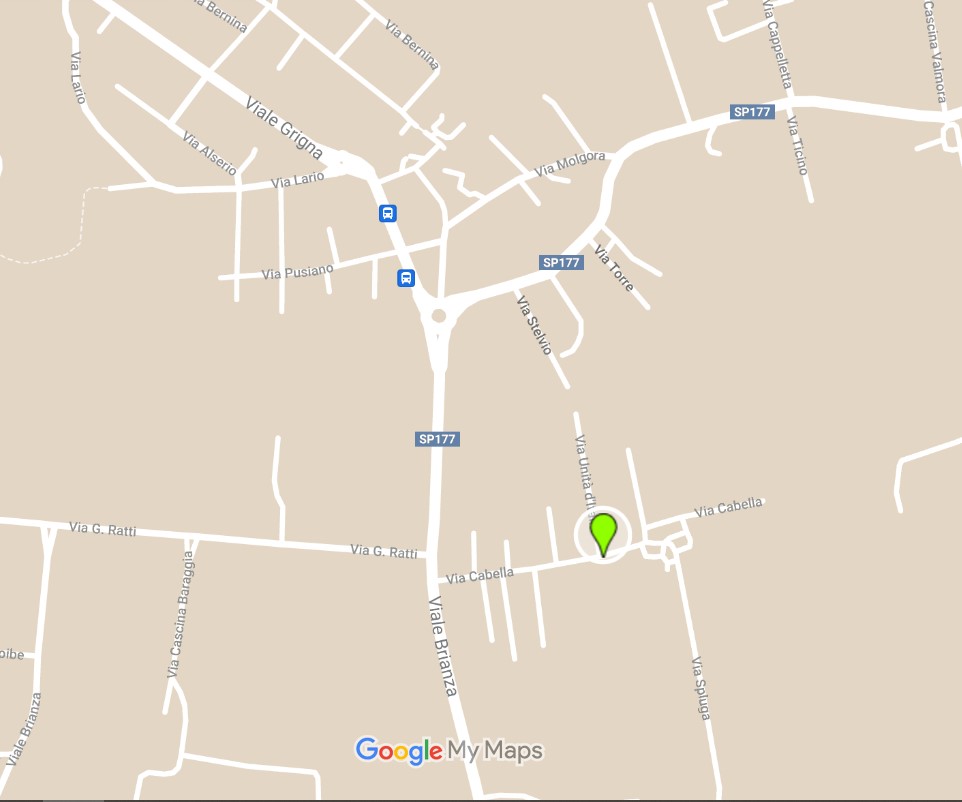
Search the known town followed by Via (street) and the mysterious toponym: usually, the old area was re-named as a street and it is now called Via XXX.
In the following map, the ancient Località Cabella is today Via Cabella.
REMEMBER!
In Italy, very often people were not travelling far. They usually moved to nearby towns in search of better working conditions, so your mystery town is probably situated close to the area you already know.
If a person mentioned in a record was coming from very far, its place of origin was often described with more precision.
So, do not wear your eyes out by trying to read difficult handwritings, and do not invent town names basing of what you think to interpretate, but investigate among existing towns and toponyms.
I hope you found this post useful.
I will be back soon with the second post of this series:
Knowing the differences between US and Italian cemeteries can be helpful to set your expectations when visiting a cemetery in search of your ancestors’ graves.
First difference: the lack of space
Most American cemeteries are vast meadows pointed by tombstones and embellished with trees, like parks.
Most Italian cemeteries are undersized in comparison to the people who must be buried, and there is no way to make them bigger. In Italy, space is an issue.
For this reason, we adopted several rules that limit the use of cemetery space.
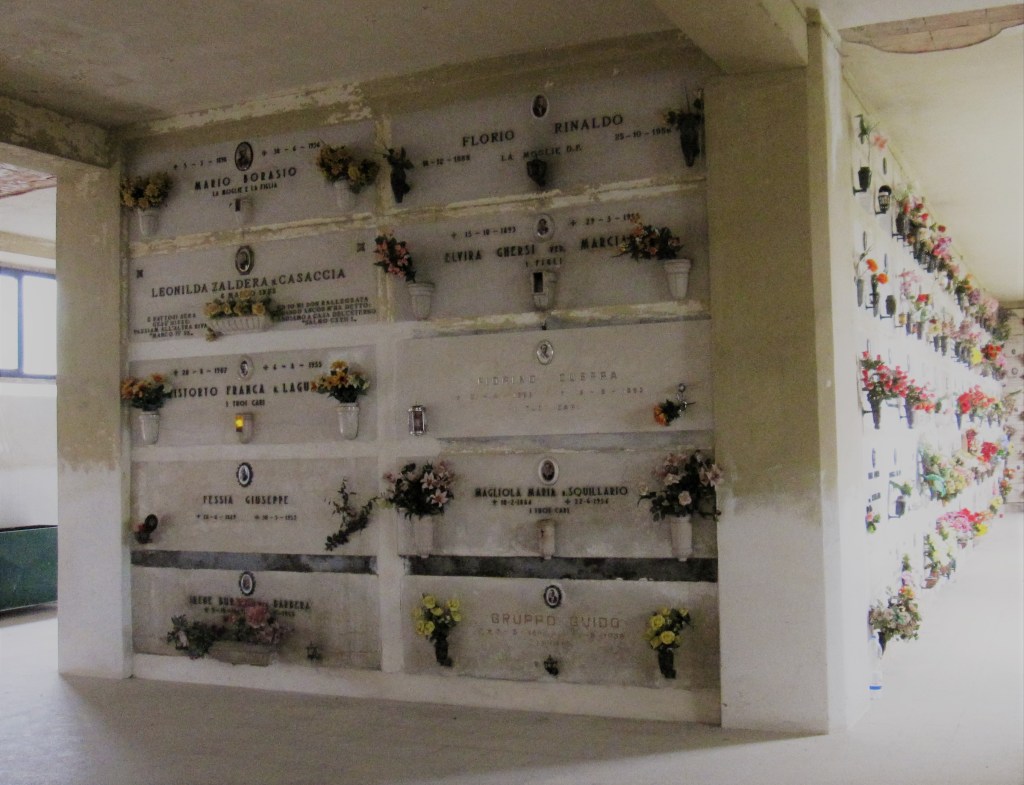
For example, only a small portion of the graves are underground. Most of them are wall burials.
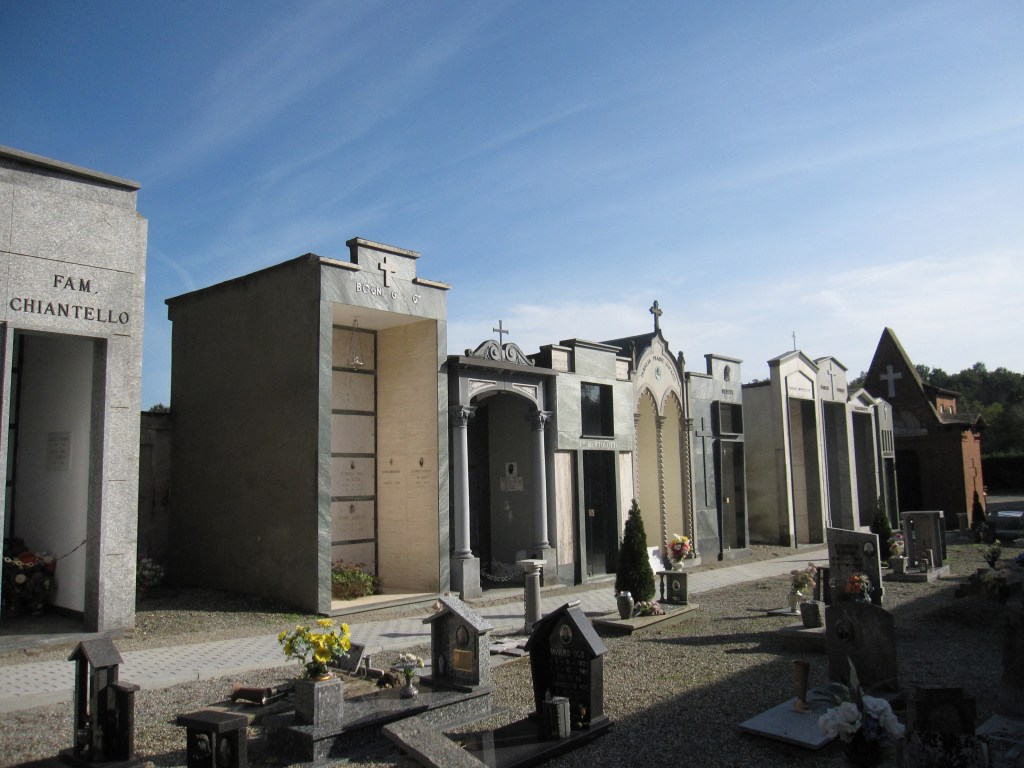
In many cases, a family chapel gathers all family tombs on multiple levels
Or the graves of many family members are gathered in a single underground grave, often enriched by artistic artwork
So, using the space vertically and gathering many burials together are two good solutions, but there is another one. A drastic one. Exhumation.
Second difference: the exhumation
It’s sad, it’s heart-breaking, it’s frustrating and disappointing and also cruel but yes: we get rid of old burials!
As said, it’s a matter of space, but the final result is that finding your ancestors’ grave requires some luck.
The general rule is: the town sets tariffs for the burials in the local cemetery. There are tariffs for underground burials, tariffs for wall burials, for urns (cremation is becoming very common, even for a matter of costs), for ossuaries etc.
In addition to this, it sets the duration of burials: 30 years or 50 years or perhaps 10 years.
At the expiry of this concession, the municipality calls the family and proposes several options.
For example, the long-dead relative can be exhumed and his/her remains can be put in a smaller (and cheaper) tomb: an ossuary.
Or it can be exhumed and the remains moved in the same grave with another relative. In this case, usually a plate is added to the main tomb.
Another solution is – if the cemetery rules allow it – to pay for an extension of the concession.
However, if the “family call” fails, the old remains are simply exhumed and laid down in a common ossuary, the last destination of our dear ones, which has the poorest and humblest look. Most often it is only a hole in the ground covered by a stone, without a tombstone, a plate or anything useful to identify our ancestors.
It is to be said, though, that some towns allowed perpetual concessions, especially in the past. In these lucky cases, the oldest graves are as old as the rule set by the town. Usually, this dates back to the beginning of the 20th century or at latest at the end of the 19th century: in Italy, finding a grave which is older than a century requires a lot of luck!
Usually, the oldest graves are those of people born in the 19th century but deceased in the 20th century.
If you read until this point, your frustration probably grew bigger and bigger at any line, but do not give up! Your search for your ancestors’ graves can still be fruitful, and perhaps even luckier than expected!
For example, if the remains of your ancestors were exhumed and moved to a family grave, you may be able to discover all family members at once. In this case, try leaving a message: you may receive a call from your Italian family!
Third difference: the pictures
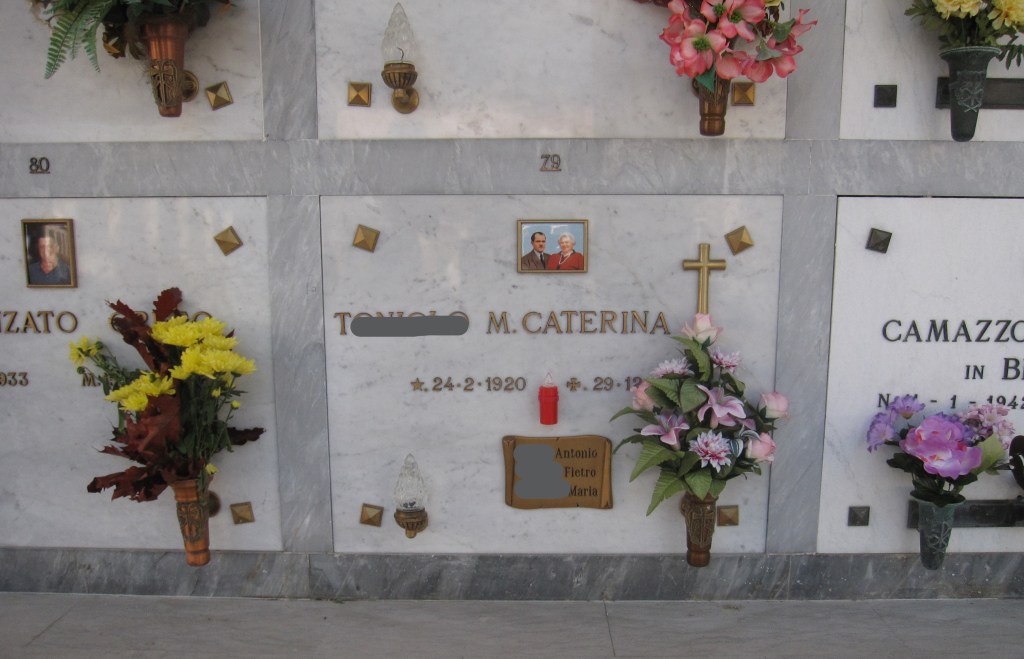
Ok, you may not find the tombs of your ancestors at all, but if you find them, it is very probable that they carry a portrait of the deceased one: it may be the only one picture of your ancestor you ever saw!
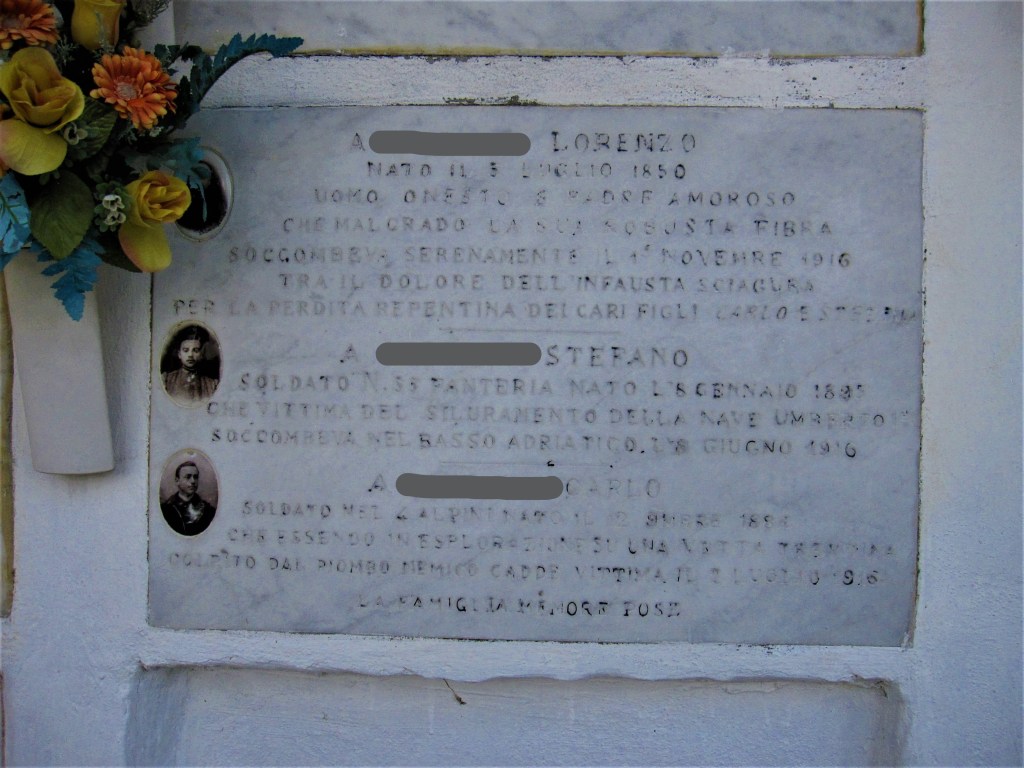
Occasionally, you may find also added info about the deceased person: in the following example, two brothers were WWI casualties and the tombstone reports the circumstances of their death.
Exceptions to the above: if your ancestors were wealthy, famous people or nobles, there is a chance more. In fact, noteworthy people were sometimes buried inside the church, not in the cemetery, and so it may be possible to find them there.
Another possibility is: if your ancestor’s grave was a remarkable artwork, perhaps it was preserved even after the expiry of the concession, for artistic reasons.
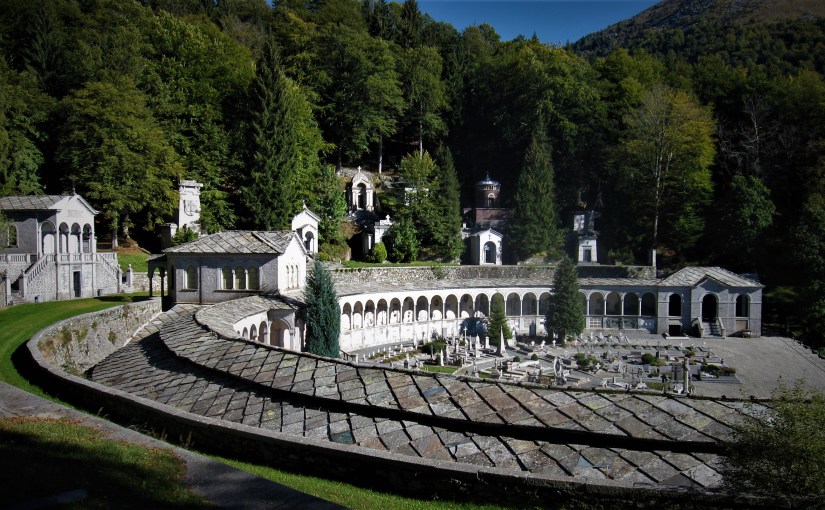
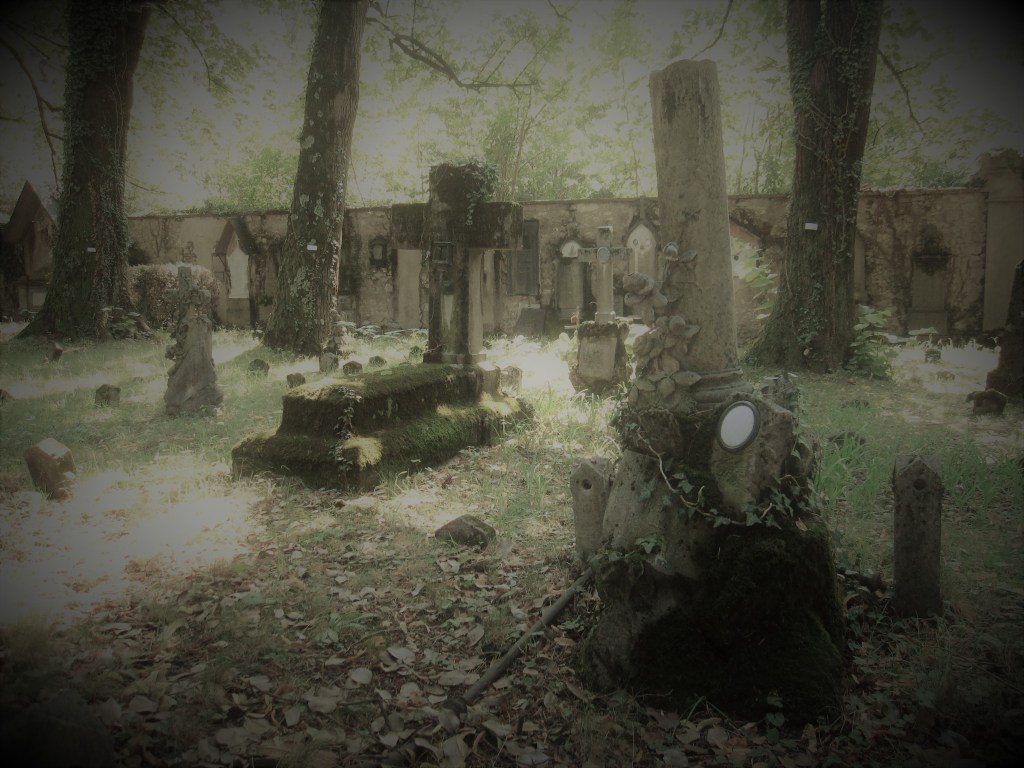
Here below, an exception: an old cemetery (19th century) that was not dismantled and it is now a kind of historical park.
I hope this article was useful. If you have doubts or question, feel free to write and ask!
Every research job shows new challenges: unknown archives to visit, mysterious families to discover, brand new problems to face.
Every customer pushes me a step forward, allowing me to do new experiences.
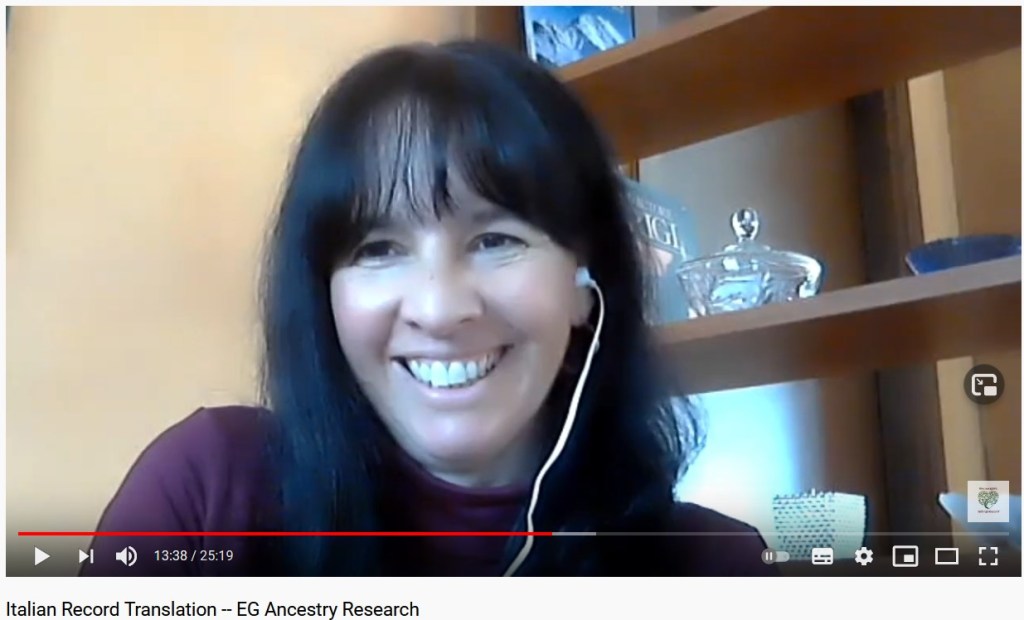
But among these, ROBERT SORRENTINO (at Italian Genealogy) is the one who really drives me to do frightening things such as… making a video and post it on YouTube!
If it weren’t for him, you would never hear me speaking and probably never see my face: I am too shy for this sort of things! But Robert was wonderful at guiding me through this unexplored territory made of videos and podcasts, so… THANK YOU ROBERT!
I would never have the courage to do it on my own!
The job he had asked me was the analysis of the will (dated 1760) of an important member of Robert’s aristocratic family: his 6th great uncle Gaspare De Riso.
It was a very interesting document with an enormous amount of info about the family members and their wealth, who allowed Robert to get as deep as knowing the ancestor’s psychology and thoughts.
His was – of course – a lucky situation which is more often to be found among noble people, but if your ancestors were farmers or smiths or even foundlings, do not despair! Perhaps, somewhere there’s a document that tells a lot about them the same. Finding it, it’s just a question of patience… and luck!
If you want to watch our Zoom chat and to learn more about the De Riso will and Robert’s aristocrat family, click on the following links.
And if you have an amazing story to tell about your family, get in touch with Robert: he will be happy to drive you to the world of podcasts as he did for me!
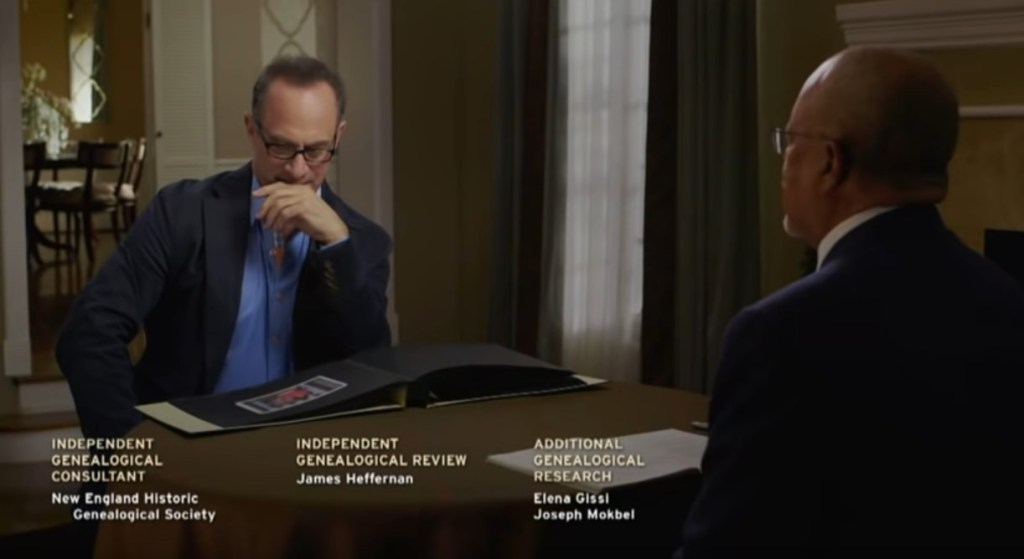
After 16 months, the episode of Finding Your Roots with Christopher Meloni was finally aired!
A shot from PBS’ Finding Your Roots – Season 7 Episode 4
PBS had contacted me in September 2019 and hired me to research the genealogy of their guest, the Italian-American actor Christopher Meloni.
It was a brand new challenge for me, that I tried to accomplish as best as I could, working for 5 days and in 8 different archives in Liguria and Emilia Romagna.
In the end, the result was:
– two family trees (for two different family lines) totalling 49 direct ancestors
– the most ancient ancestor, Christopher’s 8th great grandfather, born around 1630
– 4 military lists
– identification of 2 houses where Christopher Meloni’s ancestors had lived
– 1 notary’s deed for the purchase of a house
– 1 local history book that a priest gave me as present
– maps, picture of places and other documents
and, of course, many stories of people who lived, worked, married and died without leaving a sign in this world except for their name in the parish records: men who were farmers, others who died of an epidemic, families who were fostering foundlings and – of course – the most striking story, that of Christopher’s great-grandfather Enrico Melone, a baby who was abandoned at birth.
It was clear from the beginning that this would have been the key story of the show and although PBS dropped all the rest – the vast majority of my job – it is clear that they couldn’t do anything else: there must be a single story or two to focus the attention on.
So, you will never know the rest about Christopher’s ancestors, I am sorry!
But don’t worry, there are other interesting and touching stories to discover: those about your own family!
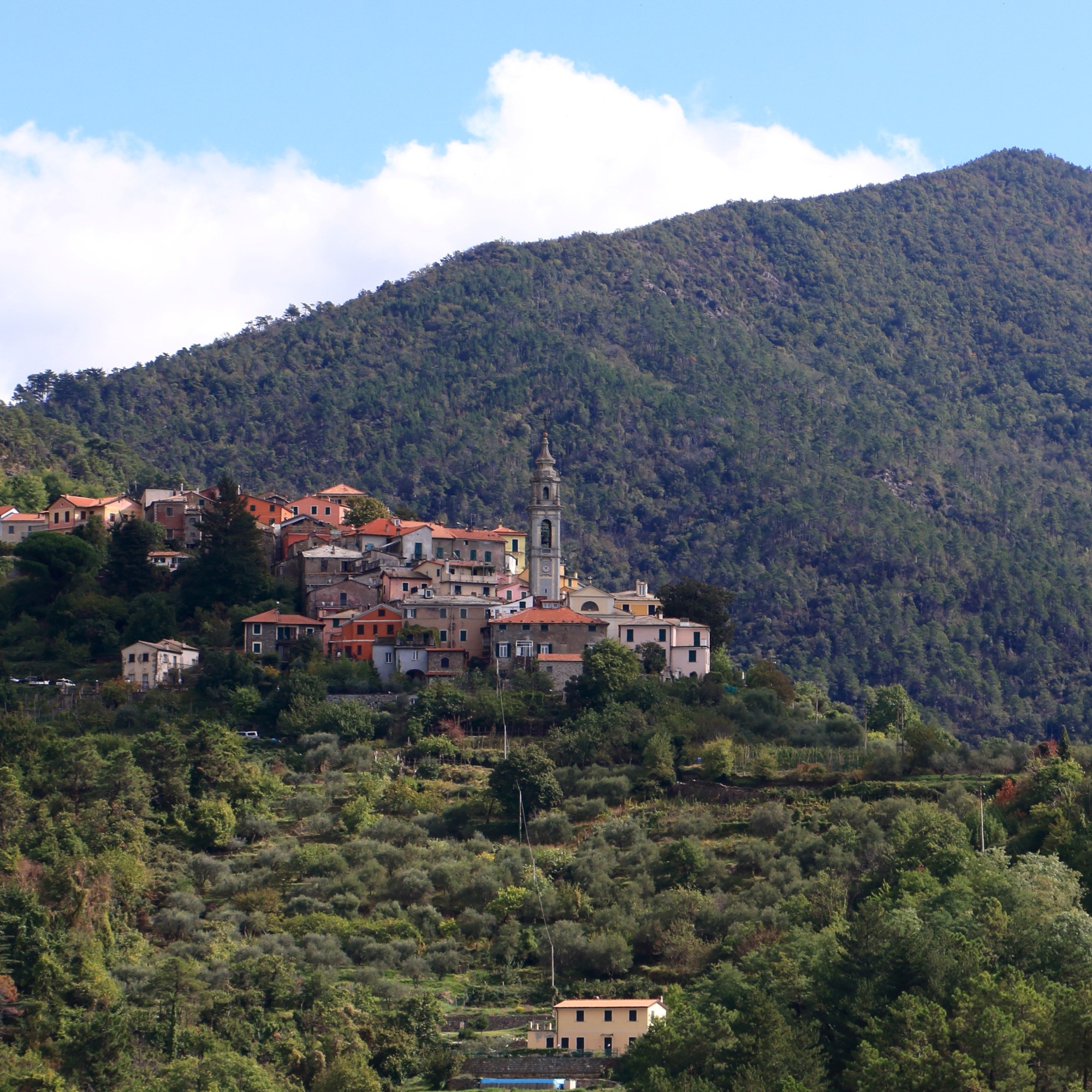
Some pictures of Velva, the place where Christopher’s ancestors were from: an amazing, picturesque village on the Ligurian hills. The town center does not have roads, only stone stairs and narrow paths.
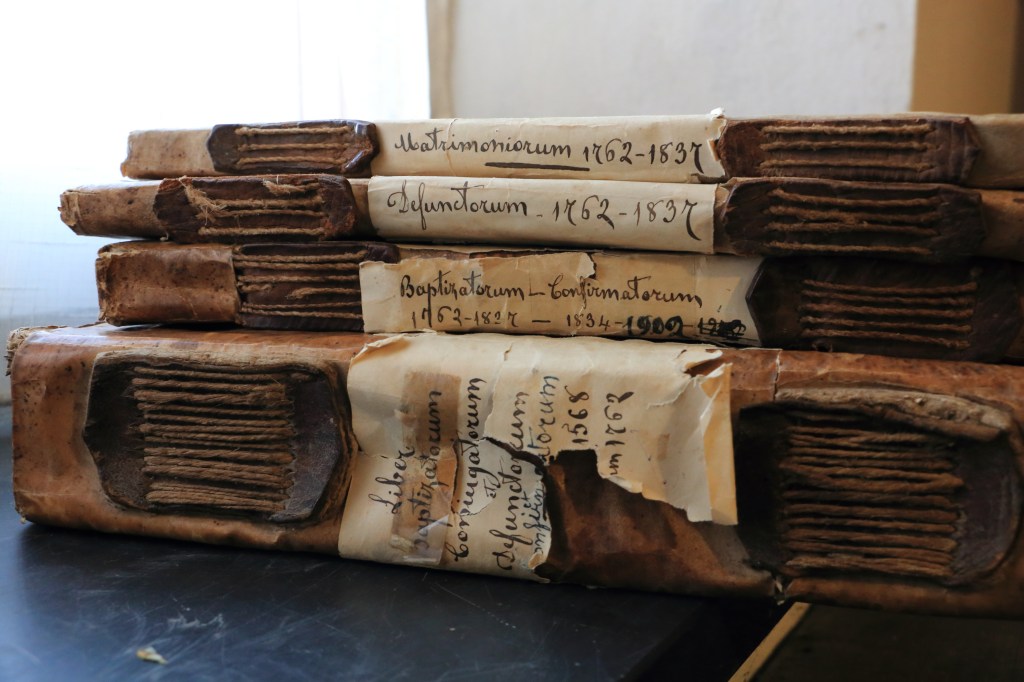
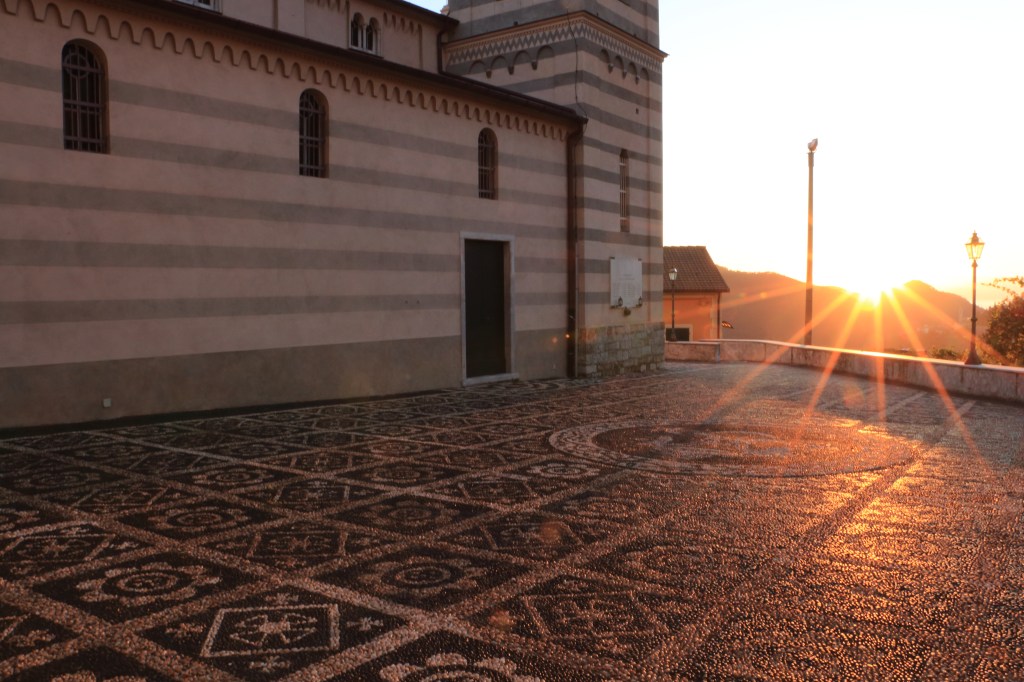
Old registersThe Missano church with the typical risseu: decorations for squares and courtyards made with small, round stones in different colors














 E. G. ANCESTRY RESEARCH